
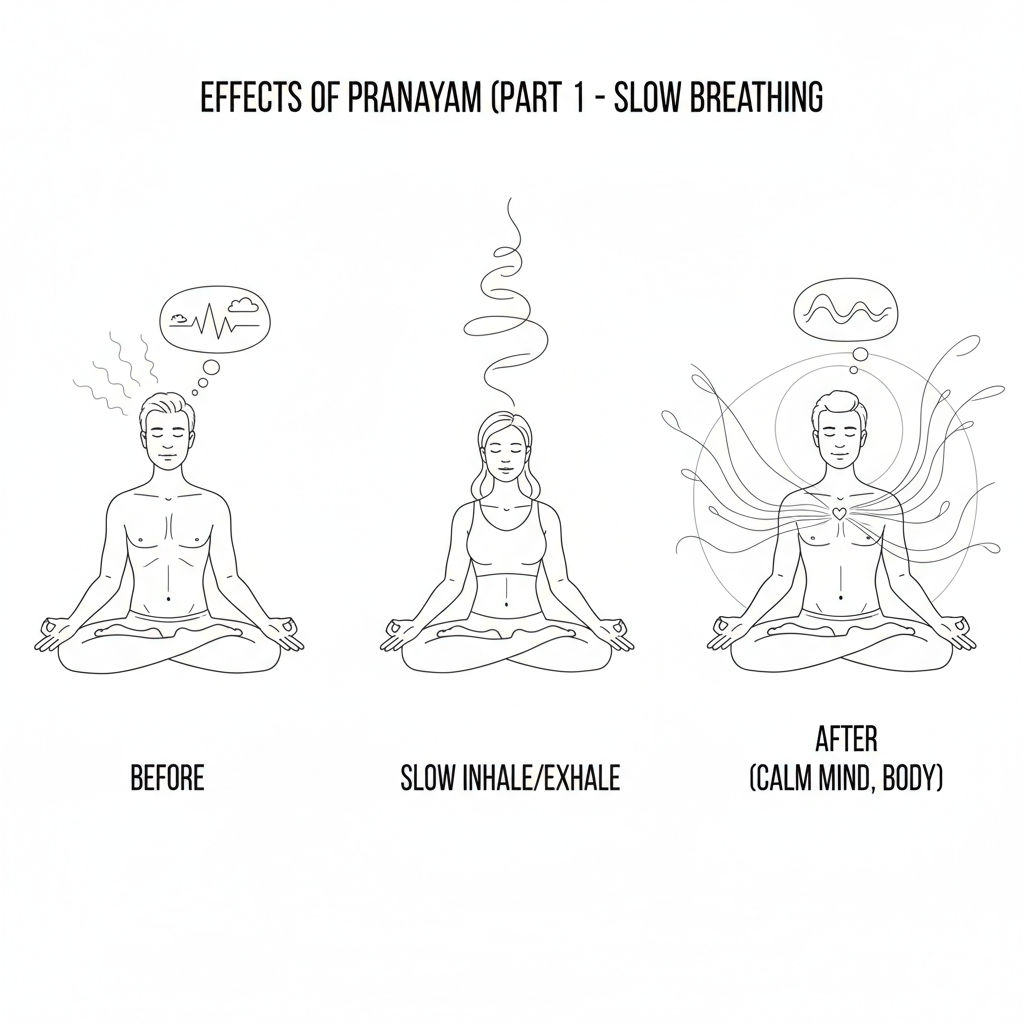
When you breathe slowly and consciously in Pranayama, a cascade of changes happens—from the breath, to the nervous system, to the mind, and finally to awareness.
1. Nervous system shifts to calm mode
Slow breathing (especially long exhalations) activates the vagus nerve. This moves the body from sympathetic (fight–flight) to parasympathetic (rest–repair) mode.
-
Heart rate slows
-
Blood pressure reduces
-
Muscles soften
2. Brain chemistry stabilizes
Slow pranayamic breathing:
-
Reduces cortisol (stress hormone)
-
Improves GABA activity (Gamma-Aminobutyric Acid), which acts as a calming neurotransmitter in your brain and nervous system.
-
Enhances oxygen–carbon dioxide balance, which sharpens mental clarity.
Result: Less anxiety, more emotional stability.
3. Cells enter an efficient energy state
With slow breathing:
-
Oxygen uptake becomes more effective, not excessive.
-
Mitochondria produce ATP steadily.
-
Cellular fatigue reduces.
Result: Sustained energy instead of spikes and crashes.
4. Mind becomes quiet and focused
As breath slows:
-
Thought speed reduces.
-
Sensory overload drops.
-
Attention naturally turns inward.
As the Patanjali yogic texts say: “When prāṇa becomes steady, the mind becomes steady.”
5. Prāṇa begins to flow consciously
In yogic understanding:
-
Slow breathing refines prāṇa movement.
-
Nadis (energy pathways) begin to balance.
-
Ida–Pingala harmonize, preparing for dhyāna (meditation).
6. Sense of time and identity softens
With continued slow pranayama:
-
Body awareness becomes subtle.
-
Emotional reactions lose intensity.
-
A quiet witnessing state emerges.
– Ravi ji 🤗


0 Comments