
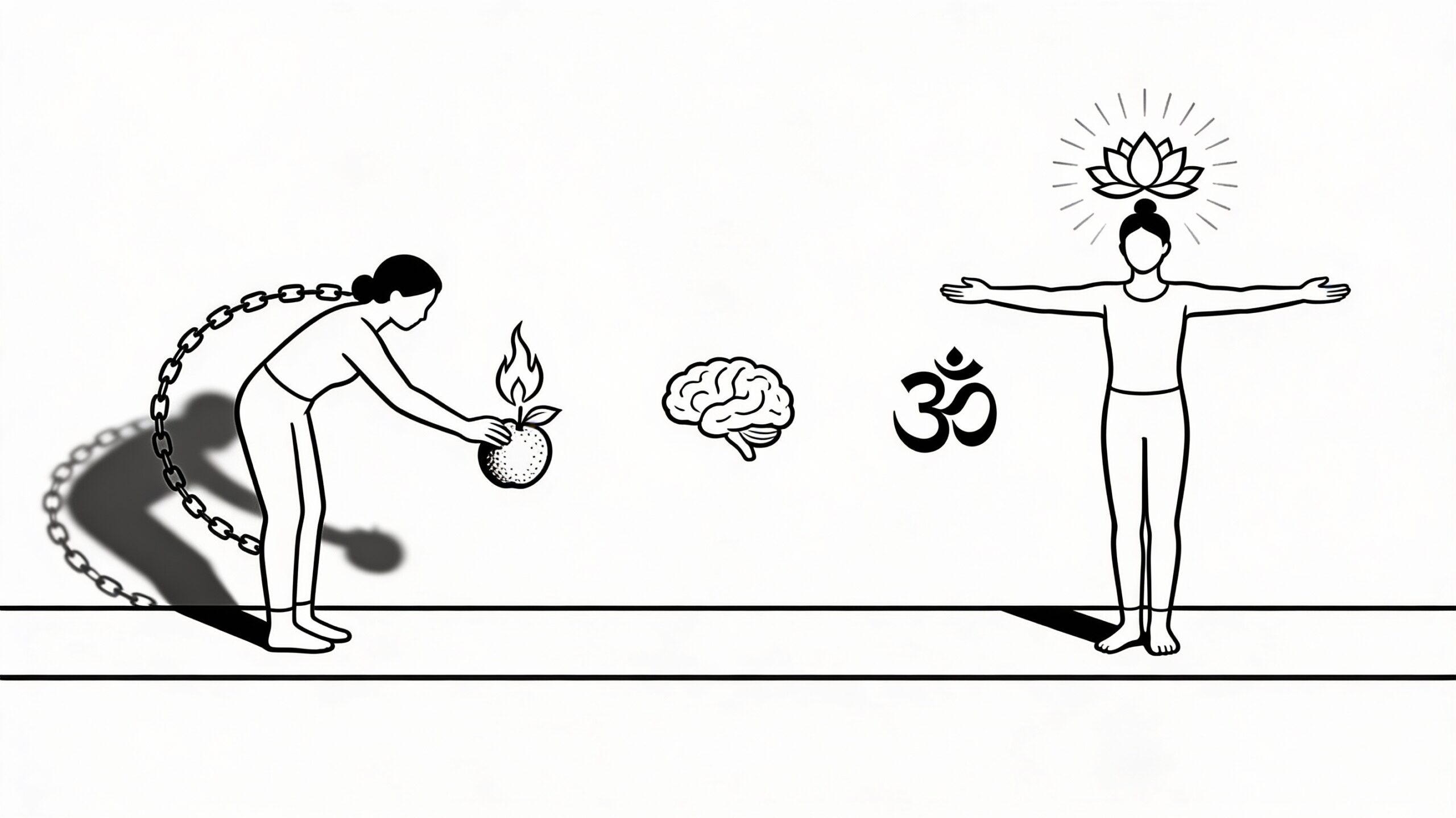
In the journey of human evolution, the interplay between desire and intellect has been a central theme of inquiry — both in ancient spiritual traditions and in modern psychology.
The Buddha, with characteristic clarity, declared:
“Desires are the root cause of all miseries.”
While this observation forms the foundation of many contemplative traditions, the ancient yogic sage Patanjali offers a deeper analysis into the origin of desires and how they affect human behaviour. His work, The Yoga Sutras, not only diagnoses the root of suffering but also provides a structured path toward liberation.
I. The Mechanism of Desire: A Scientific Unfolding
Modern behavioural science suggests that most human actions are driven by past experiences encoded in memory. Patanjali articulated this ages ago:
“Desires arise from the impressions of past pleasurable experiences stored in memory.”
In Sanskrit, “Chitta” refers to the memory-based aspect of the mind, while “Vritti” refers to its movements or tendencies. Thus, Chitta Vritti signifies the restless waves of memory that arise again and again, seeking repetition of past sensory pleasures.
II. The Conflict: Intellect vs. Memory
Within the mind (Antahkarana) exists an intrinsic hierarchy of faculties:
• Chitta (Memory): The storehouse of impressions and experiences.
• Buddhi (Intellect): The discerning, decision-making faculty.
• Manas (Mind): The sensory, reactive layer that interfaces with the world.
• Ahankar (Personality): Through which everything is visualised and acted upon.
Ideally, Buddhi (intellect) must govern the impulses of Chitta based on the Personality one carries. But when Chitta becomes dominant — overwhelming the intellect with vivid recollections of past pleasures — the mind is tempted into repeating those actions, regardless of consequences. This is the mechanism of temptation.
When Buddhi is weakened, memory dictates the mind’s response, leading to impulsive behaviours, addictions, and mental suffering. One succumbs to temptations not by external triggers alone, but because of internal memories craving re-experience.
III. The Cycle of Suffering: From Desire to Misery
Here is the sequence as explained in both yogic and cognitive terms:
1. Pleasurable experience →
2. Memory formation (Chitta) →
3. Desire to repeat (Chitta Vritti) →
4. Intellect warning ignored →
5. Mind acts impulsively through senses →
6. Unwise action → Misery
7. Misery becomes another memory → Further Vritti
This feedback loop ensures that suffering is perpetuated — unless consciously broken.
IV. The Yogic Solution: Chitta Vritti Nirodha
Patanjali defines Yoga as:
“Yogah Chitta Vritti Nirodhah”
(Yoga is the cessation of the fluctuations of memory impressions.)
In practical terms, Yoga trains the intellect (Buddhi) to regain control over memory-driven impulses by establishing a divine personality. Through meditative practices, breath regulation, ethical living, and deep self-awareness, the practitioner learns to:
• Recognize memory-based desires as patterns
• Observe them without engagement
• Allow them to dissolve through non-reinforcement
• Strengthen Buddhi through discernment and detachment
This leads to inner mastery, freeing the individual from the tyranny of unconscious patterns.
V. Contemporary Relevance: A Science for Modern Minds
Modern neuroscience speaks of neuroplasticity — the brain’s ability to rewire itself. Yogic practices stimulate this by creating new neural patterns where intellect-led decisions dominate over instinctual reactions.
Thus, Yoga is not merely a spiritual path — it is a cognitive technology for emotional and behavioural transformation.
VI. Learn More: Raviji’s Infanity’s Yogic Education for Modern Parents and Seekers
At Raviji’s Infanity Education, under the guidance of Sri Raviji, we explore the scientific depth of yogic wisdom tailored for contemporary life — especially for parents, educators, and aspirants seeking freedom from conditioned patterns.
Our programs offer a blend of:
• Classical Yoga psychology
• Practical meditative tools
• Family-centric mind management
• Emotional intelligence through ancient insights
Begin your journey from temptation to transformation. Learn how to master the Chitta Vritti and reclaim your inner freedom.
“When the intellect rules over memory, clarity is born. When memory rules over intellect, confusion reigns.” – Raviji
Let Yoga guide you back to clarity, balance, and bliss.

0 Comments